Look Back Review (2026 Toronto Film Festival)

In 2024, we were blessed with a faithful anime adaptation of Tatsuki Fujimoto’s one‑shot manga Look Back. Taking the world by storm, it stood out as one of the year’s best anime films. So, when it was announced in December 2025 that Hirokazu Kore‑eda was working on a live‑action adaptation of the same manga, I was perplexed, assuming we already had the definitive version of this story. Oh, how wrong I was.
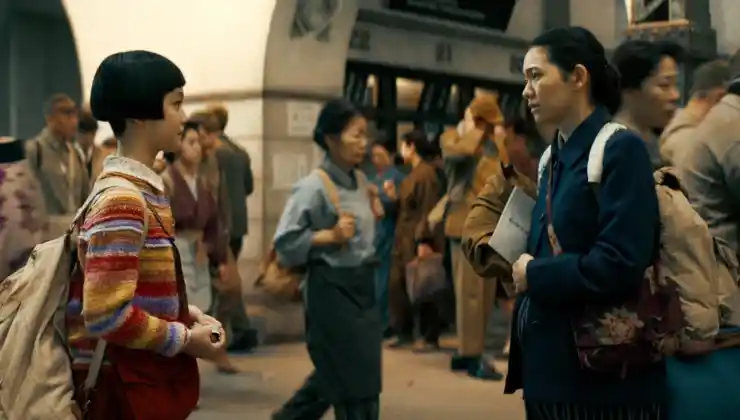
Fujino (Furi Nanase) is an elementary schooler who writes yonkoma (four‑panel gag) manga for her school’s paper. One day, at her teacher’s request, she’s asked to give up some of her space so that Kyomoto (Rokka Okada), a shut-in student, can contribute to help her gradually return to school. What begins as a rivalry soon blossoms into a friendship when Fujino is asked to deliver Kyomoto’s middle‑school diploma. Kyomoto emerges from her room to reveal that she has been a fan of Fujino’s work for a long time.
From there, we see the duo create a manga for a competition and eventually move on to producing one‑shots. From the very beginning, it’s clear that Kore-eda has a deep respect for the source material and for Fujimoto’s work. From the opening shot and title card replicating the front cover of the one‑shot. To the inclusion of one‑shots that reference Fujimoto’s earlier works, such as Mermaid Rhapsody. Yet what I feel truly elevates this incarnation is that it becomes an embodiment of what art is.
Fujino’s editor tells her that art becomes its own thing, something beyond what the creator ever intended. This idea is highlighted perfectly here, because first and foremost this is a Kore‑eda film. Everything is filtered through the lens of a filmmaking master: from the lush, soft 35mm cinematography that captures the world of creativity with breathtaking intimacy. To the wonderfully cinematic score that is nothing short of perfection. The power of why we create is on full display, especially in the moment when the two girls plough through the snow to see whether their manga has won the competition, which is a scene of pure cinematic joy.
However, it’s the new elements Kore‑eda introduces that allow this film to become special. A simple addition, like seeing Fujino’s former teacher believe in her and take pride in his former student, is genuinely sweet. More substantial additions, such as spending more time with the characters as they draw. Especially during the creation of their competition manga, deepen the emotional texture of the story. These moments were depicted quickly in both the manga and the anime, but allowing them to breathe helps us understand and cherish their desire to draw. It lets the themes of creativity shine, and it makes the film’s final third genuinely and profoundly affecting.
It helps that the actors playing the younger and older versions of Fujino and Kyomoto are exceptional. In the beginning, as we watch their friendship take shape, Nanase and Okada are truly magnificent. Allowing their enormous dreams of creating manga to come to life in unimaginable and profound ways. The transition to Natsuki Deguchi and Aju Makita is utterly seamless. Their performances carry the emotional weight of the second half, leading to moments that nearly brought me to tears.
“Why do you draw?” It’s a question Kyomoto asks, and it made me think: why do I write? I’ve always believed I knew the answer, but this film made me truly feel and understand it. The film loudly proclaims, do not look back in anger; look forward to what you can create and what you can bring to the world. Look Back is a cinematic masterpiece, a truly wonderful and emotionally triumphant journey.
★★★★★
Had its North American Premiere at the 2026 Toronto Film Festival / 14th October 2024 UK Premiere at the 2026 BFI London Film Festival / Natsuki Deguchi, Aju Makita, Furi Nanase, Rokka Okada / Dir: Hirokazu Kore‑eda / GKIDS

Discover more from
Subscribe to get the latest posts sent to your email.
About the Author


You must be logged in to post a comment.