Little Trouble Girls Review
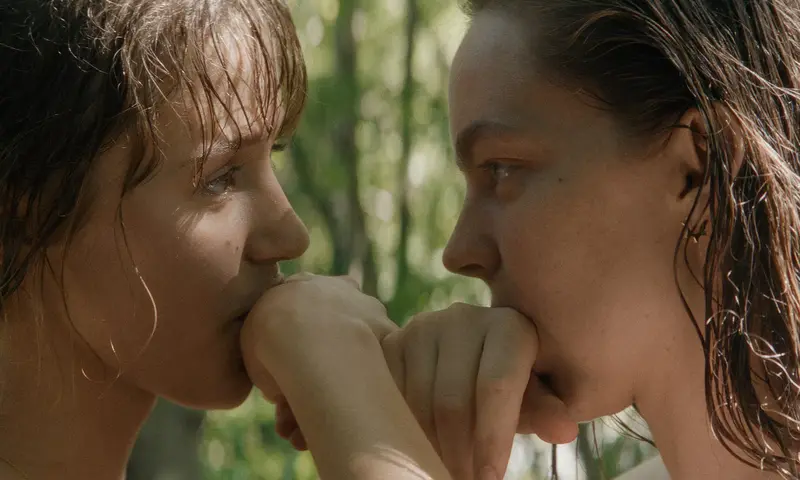
Early on in Urška Djukić’s debut feature, Little Trouble Girls, Ana-Marija (Mina Švajger) delicately smears lipstick onto Lucija (Jara Sofija Ostan)’s lips with her fingertips, providing her very first taste of desire. Following a Catholic school’s all-girl choir, the film is a queer story of blossoming sexual yearning, which takes an unexpected approach to the coming-of-age genre.
Lucija is a timid sixteen-year-old daydreamer who befriends the rebellious school choir it-girl, Ana-Marija. The girls are immediately drawn to one another; Lucija is captivated by Ana-Marija’s determined want to push the boundaries of her virginal temperament, despite her mother’s warnings and her music teacher’s disapproval. The choir, along with their stern but pitiable music teacher (Sasa Tabakovic), travel to a rural Italian convent to rehearse. Once there, longing glances and soft touches turn into passionate kisses and deep yearning. Yet, Djukić doesn’t take the well-trodden path through queer cinema to explore these urges.
Djukić makes clear her intent to intertwine the girls’ sexual urges with the religious devotion surrounding them, layering the sensually tinged moans and pants of their vocal exercises with religious imagery. During a conversation with Sister Magda (Saša Pavček), one of the convent’s nuns, the girls enquire about her urges, and if she misses hugs or the feel of a lover’s fingers running through her hair. In return, she speaks about devotion and the pleasure in giving her body in marriage to Christ. However, hormones spike and pulses quicken when desire manages to permeate the heavenly space in the form of workmen, who interrupt the girls’ rehearsals with their construction, leaving Ana-Marija and Lucija with nothing better to do than watch the sweat drip from their semi-clothed bodies.
Exposed to the world of adult sexuality, Ana-Marija pushes Lucija to embrace her urges, and during a late-night game of truth or dare, she dares her to “passionately kiss the most beautiful girl in the convent”. A more obvious film would see Lucija make a brave advance toward her crush, but instead, in Little Trouble Girls, the girls creep through the convent in the dark after Lucija and watch her brush her lips against a glowing white statue of the Virgin Mary. It’s this bold disregard for the rules of the game that makes Djukić’s work so interesting; she entangles the girl’s expanding urges into the world from which they come, and it’s absolutely fascinating to watch the convent become invaded by sexual awakening.
The cinematography is tangible, alive with nature and the visual poetry of the beautiful space. There’s a certain smell to a catholic church, which you can almost remember as the camera moves around the dusty pews and sun-baked corridors of the convent. The considered camera placement, boxy ratio and unexpected whimsy of the film recall the raw and exciting talent Alice Rohrwacher showcased in her exceptional La Chimera. Imagery of blossoming flowers alongside the eerie soundscape of whispers, sighs, and harmonised voices makes for an affectingly sensual cinema experience.
Little Trouble Girls is a vital contribution to queer cinema, and Urška Djukić is an interesting emerging voice. The filmmaker’s understanding of what it is to yearn is quintessential to her storytelling. Though some might feel her story beats are understated, there’s an undeniable truth to her comprehension of being a young woman experiencing the duelling forces of desire and shame.
★★★★★
In cinemas August 29th and available on the BFI Player from October 13th / Mina Švajger, Saša Pavček, Jara Sofija Ostan, Sasa Tabakovic / Dir: Urška Djukići / BFI/ 15
Discover more from
Subscribe to get the latest posts sent to your email.
About the Author