Klara and the Sun Review (2026 BFI London Film Festival)
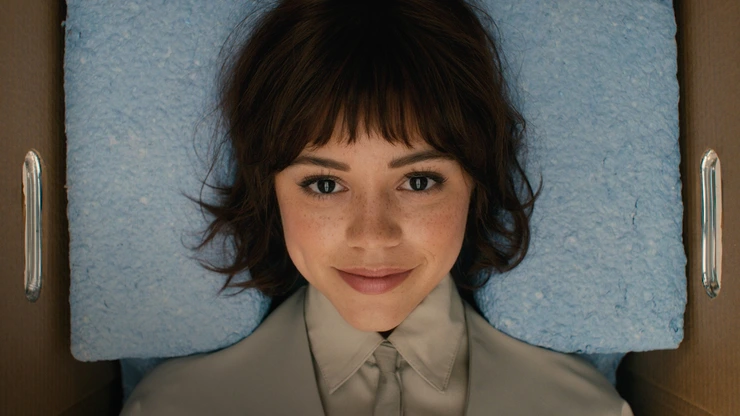
Taika Waititi’s Klara and the Sun is a heartwarming science-fiction drama about love, loss, and what makes us human. Adapted from Kazuo Ishiguro’s 2021 novel, the film follows an Artificial Friend whose devotion to a seriously ill teenager leads her into a family struggling with grief and the fear of losing someone they love. While the story is emotionally engaging, its predictable narrative and superficial treatment of its central ideas leave much of its potential unexplored.
Klara (Jenna Ortega) is an AF designed to keep young people company. Unlike the other robots in the shop where she lives, she has an unusual way of observing the world, interpreting human behaviour through her own understanding of life. When Josie (Mia Tharia), a seriously ill teenager, chooses her as a companion, Klara enters a family whose seemingly comfortable life conceals a painful history. As she adjusts to her new surroundings, we discover the family’s circumstances alongside her, gradually learning about Josie’s condition and her mother’s desperate attempts to cope with the possibility of losing another child.
The film’s most interesting ideas emerge through the contrast between Klara’s devotion and the humans’ attempts to deal with loss. Klara believes that the Sun possesses a healing power that can save Josie, while those around her place their faith in technology. This contrast gives the story an almost spiritual dimension, particularly as Klara’s understanding of the world remains grounded in her sincere belief that she can help her friend. The cast is well suited to the material, with Ortega conveying Klara’s unwavering devotion and Amy Adams portraying Chrissie as a mother whose controlling behaviour conceals profound grief.
The central conflict develops when Capaldi (Steve Buscemi), a mysterious scientist, proposes using Klara to help recreate Josie’s personality. For Chrissie, who has already lost one daughter, the possibility of preserving another becomes difficult to resist. The premise has the potential to raise uncomfortable questions about the possibility of reproducing a person through artificial intelligence. However, the film is less interested in exploring the implications of Capaldi’s project than in using it to reinforce its emotional message: that love cannot be artificially reproduced and that a copy cannot replace the person who inspired it.
Read more of our LFF 2026 coverage →
At one point, the film asks, “What good is perfection? What is it for?” It is a question that could have served as the foundation for a more substantial exploration of the story’s ideas, from the genetic enhancement that has made Josie exceptionally gifted to Capaldi’s attempt to recreate her. Instead, the film largely leaves these threads undeveloped. It gestures towards the ethical and philosophical implications of its futuristic setting without engaging with them in any meaningful depth. When artificial intelligence is an increasingly prominent part of public conversation, this uncomplicated approach feels like a missed opportunity.
The narrative is also predictable, with its major revelations and emotional turning points rarely offering much surprise. Once the family’s circumstances become clear, the direction of the story is relatively easy to anticipate. Although the emotional stakes remain effective, the film’s preference for sentiment over complexity prevents its more intriguing ideas from gaining much weight. Nevertheless, it remains an engaging watch. Despite its almost two-hour runtime, the story moves along smoothly, and its heartwarming approach makes it an accessible meditation. Klara’s unwavering devotion to Josie is genuinely touching, while the conclusion offers a bittersweet reminder that meaningful connections do not need to last forever to matter.
Klara and the Sun is more successful as an emotional story about love and loss than as a deeper exploration of artificial intelligence. Its central message is moving, but the film seems content to arrive at a comforting conclusion without fully exploring the questions that could have made it more compelling. In trying to show us what makes love irreplaceable, it leaves us wondering what more its own story could have achieved.
★★★
Playing as part of the 2026 BFI London Film Festival on October 15, 16 and 17 / Jenna Ortega, Amy Adams, Mia Tharia, Steve Buscemi, Natasha Lyonne / Dir: Taika Waititi / Sony Pictures Releasing UK / 12A

Discover more from
Subscribe to get the latest posts sent to your email.
About the Author



You must be logged in to post a comment.