Interview: Kensuke Sonomura on His Approach to Action And How It Enchances Narrative And Mixing Dark Themes with Comedy
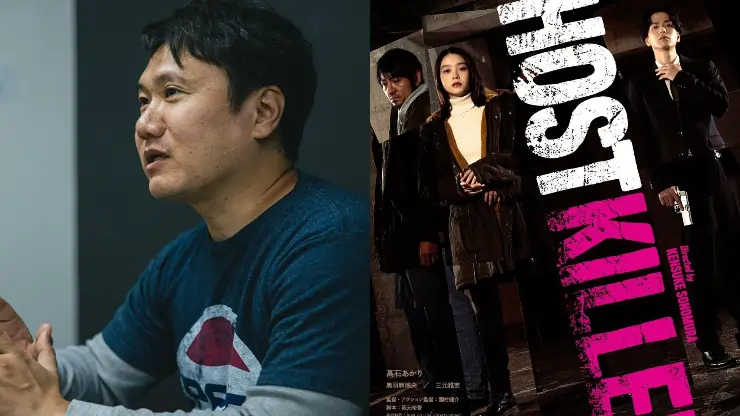
Action films, especially those from East Asian cinema, always skyrocket to the top of my festival watchlist. So seeing that the latest film by one of the best action directors working today, Kensuke Sonomura, Ghost Killer, was showing at Glasgow Film Festival. My interest was piqued, and being given the opportunity to ask director and action director Kensuke Sonomura questions, I was ecstatic.
Ghost Killer follows Fumika Matsuoka, a down-on-her-luck college student grappling with the stress of trying to stay afloat. One day she stumbles upon a bullet case that she pockets, however, upon picking up the case she starts to see Kudo, a hitman that was recently killed and is now a Ghost. Believing that Kudo will only move on if they fulfil his quest for vengeance, Fumika agrees to help him.
In this exclusive interview, I asked Kensuke Sonomura questions via email before the UK Premiere of Ghost Killer at the Glasgow Film Festival about his approach to action, mixing dark themes with comedy and how action advances the narrative. I also was able to ask questions about Baby Assassins: Nice Days, a film he was action director for that is also having its UK Premiere at the Glasgow Film Festival.
Your previous film, Bad City, was a homage to V-Cinema. Were there any genres or films that directly inspired Ghost Killer?
Kensuke Sonomura: This film has a unique setting, so I can’t say it was influenced by any specific genre. In my previous works, I’ve primarily directed serious films with male protagonists, and I’ve always considered that genre to be my strength. That’s why, at first, I felt a bit uncertain about this project—it was my first time directing a film with a female lead, and on top of that, it had comedic elements. When I first read the script, I felt that it strongly reflected Sakamoto’s style, to the point where I even wondered if the film would be more interesting if he directed it instead of me. I wasn’t confident at first, but the story itself was so compelling that I became convinced it would be a great opportunity for me to grow as a director, which is why I decided to take on the challenge.
Right from the beginning, your signature style to action is front and centre. Can you briefly go over how you approach the action scenes? Do you do pre-viz the action beforehand, or do you work it out on set?
Kensuke Sonomura: I almost always create previsualizations (previs) for action scenes, except for the simpler ones. I’m not a fan of choreographing on set because the limited time makes it difficult to refine the movements properly. That said, we don’t necessarily stick to the previs exactly during filming. I keep adjusting and fine-tuning the choreography right up until the last moment to make the action as engaging as possible.
Ghost Killer tackles very serious subject matters like date rape, domestic violence and men being in control of women. How did you approach directing those scenes, and what was the process like striking the right balance between serious drama and funny action film?
Kensuke Sonomura: When I first read the story, I saw its central theme as the psychological growth of a powerless woman who, after being possessed by a ghost, is unwillingly drawn into the conflicts of the underworld and forced to overcome various hardships.
To reinforce this, the men Fumika fights needed to serve as sources of stress for her. At the same time, for the audience to empathize with Fumika, they also had to experience that same stress. That’s why I created ruthless antagonists whose actions would make viewers feel the tension alongside her. By defeating these enemies, the audience can experience a sense of catharsis.
Fumika is an ordinary woman—she isn’t naturally skilled in combat, and there’s an inherent physical disparity between men and women. While she resists Kudo, she ultimately chooses to use the abilities she accidentally acquired for justice. In doing so, she also influences Kudo, guiding him toward a better path. This mutual growth forms the core of the story. To emphasize that transformation, it was essential to establish Fumika’s starting point as someone completely disconnected from the underworld—a regular college student—while Kudo comes from a world where killing is second nature. Their starkly different values and their constant miscommunication form the backbone of the film’s comedy.
To highlight this contrast, I directed Kudo to exhibit a childlike innocence despite his warped moral compass. Meanwhile, since Fumika’s body is controlled against her will, I wanted to make sure that her facial expressions didn’t always match her actions, enhancing the comedic effect. However, I deliberately avoided adding comedy to the fight choreography itself. By making the action sharp and realistic—focusing on precision and targeting vital points—the contrast with Fumika’s out-of-place reactions during battle creates humor without undermining the intensity of the action scenes.
In the final fight scenes, there are some incredible transitions during the action between Fumika Matsuoka and Hideo Kudo. Where did this idea come from, and how difficult was it directing those scenes to make sure the transitions were so seamless?
Kensuke Sonomura: Structurally, this story doesn’t allow Fumika and Kudo to fight enemies side by side. However, as the film progresses, their emotional bond strengthens, and I wanted to create the impression that they were fighting together. That’s why I chose this particular approach—to visually express that while they share one body, their wills are aligned.
The idea came to me during location scouting when I noticed a space with many pillars. I decided to use a classic practical technique: having one character disappear behind a pillar and another emerge on the other side. This old-school analog method proved to be very effective.
As an action director, I’ve often used similar techniques in other films—seamlessly switching from a stunt double to the lead actor to make it appear as if everything was done in a single shot. Because of that experience, executing this sequence wasn’t particularly challenging for me.
There have been some noticeable trends with your action, such as the gun-fu approach to gunfights and oddly, people sliding across the floor. How challenging is it to keep your action distinctly you while also ensuring that Ghost Killer remains unique in its own right?
Kensuke Sonomura: What I always strive for is making choreographed action look like a real fight. To achieve that, I believe the moments between the hits—when there’s no physical contact—are just as important as the strikes themselves.
In an actual fight, there’s constant thinking: maintaining distance, strategizing the next move, and figuring out how to land a hit. Because effective attacks require strategy, I incorporate a lot of feints into my action sequences. Ignoring this and focusing only on direct contact makes the action feel staged and less believable.
To me, this is no different from a dramatic scene where the performance relies solely on dialogue, neglecting the silent moments in between. Attention to these details, while maintaining entertainment value, can completely change how an action scene is perceived. Even if a fight sequence is physically impossible in reality, digging into these subtleties can make it feel real—something that may not actually happen, but looks completely convincing on screen.
Ghost Killer solidifies that you are one of the greatest action directors working today. You have mastered the idea that action is a form of storytelling, much like a dance number in a musical. How important is it to you that when an action scene takes place, it contributes to or advances the narrative?
Kensuke Sonomura: Unfortunately, some directors see action as just another element in a film—something flashy that exists for spectacle and nothing more. I’ve even been told that action just needs to be “visually exciting” and doesn’t require anything deeper.
But I strongly believe that every action scene should have its own story. If there’s no story driving the action, then there’s no reason for it to go on for too long. Action without narrative becomes mere performance—just a showcase of moves that could be cut from the film without affecting the story.
That’s why, when designing action sequences, I always start with storytelling. I spend a lot of time on this process because, in a way, my role is similar to that of a screenwriter who specializes in action. And just like any writer crafting a compelling story, I have to make sure my action sequences engage the audience.
To me, every movement in a fight is like a line of dialogue—a form of physical storytelling that transcends language barriers and can be understood by audiences worldwide.
You also worked on Baby Assassins: Nice Days as the action director. I wanted to know, do you approach the action direction differently when you are working under Yugo Sakamoto’s vision compared to when you’re the director?
Kensuke Sonomura: Since Sakamoto trusts my style, there’s very little difference between directing action for his films and for my own. The main difference is that when I’m working on someone else’s project, I can focus entirely on the action.
When I direct my own films, I have to juggle many other aspects beyond the action, which adds to my workload. Being able to concentrate solely on choreographing and executing action sequences allows me to refine the details even further.
Akari Takaishi stars in both Baby Assassins and Ghost Killer. How did you approach making sure her combat styles were unique between both projects?
Kensuke Sonomura: In the Baby Assassins series, Chisato’s action style reflects her personality—at her core, she wants to avoid anything too exhausting. To differentiate her from Mahiro, who fights head-on with physical strength, I directed Chisato’s movements to be more cunning and effortless, emphasizing a sly, almost carefree demeanor.
However, in Ghost Killer, it’s essentially Kudo who is fighting as well, so the approach had to be different. The action was designed to be more professional—focused on efficiency, targeting vital points with the shortest possible movements. I also had Takaishi adopt a more masculine stance and posture to reinforce this fighting style.
Although Takaishi hadn’t specialized in action before, she steadily improved through her experience in the Baby Assassins series, leading up to this role. She has incredible acting skills, which give her movements a strong sense of credibility. Her ability to differentiate performances within action scenes shows her depth as an actress, and I truly think she’s an exceptional talent.
Ghost Killer will play Glasgow Film Festival on 2nd March.
Discover more from
Subscribe to get the latest posts sent to your email.
About the Author