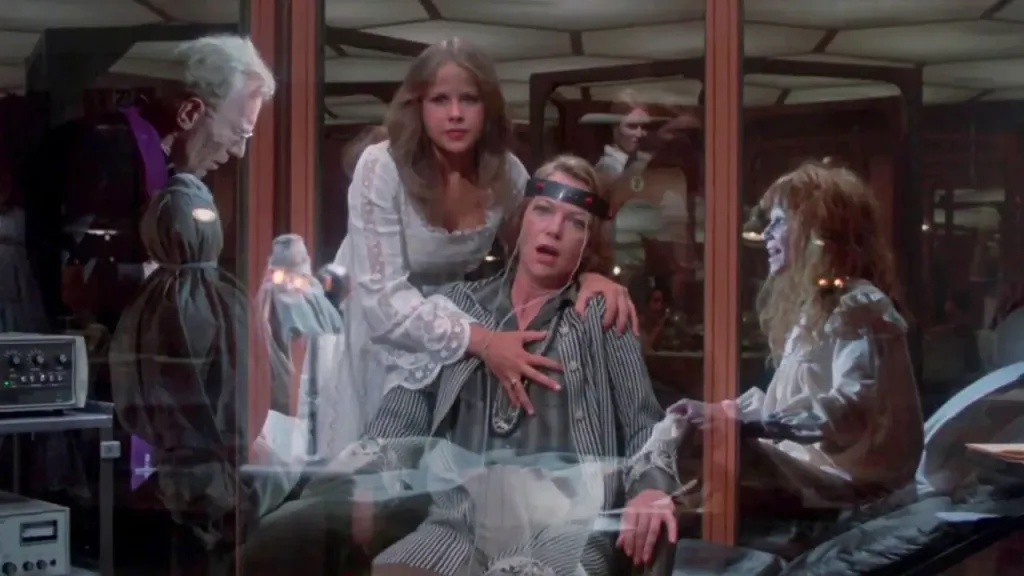
Interview: Alexandros Voulgaris on They Come Out of Margo (KVIFF 2025)
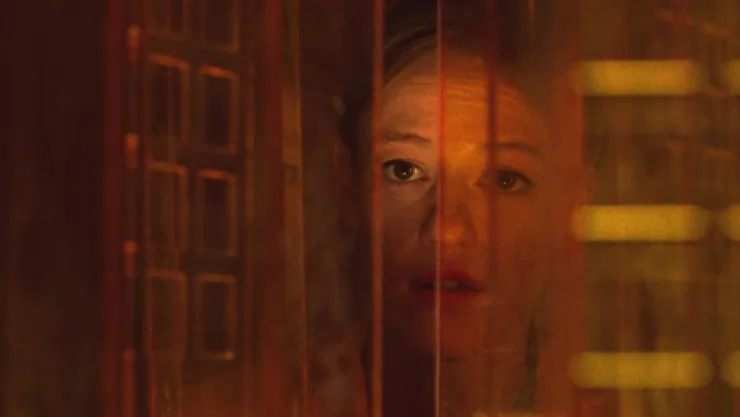
Making art is the closest we come to alchemy: no one quite understands it, but somehow it works. Being the artist, the carrier of that strange magic, is rarely fun. Sometimes, it’s even tricky (better not to try it at home.)
In his eighth feature, Alexandros Voulgaris explores that magic, both in subject and in form. Margo (Sofia Kokkali) is an acclaimed musician who hasn’t released anything in seven years. Today, on her 40th birthday, she longs for the experience of motherhood. Instead, she’s confined to her apartment in Athens, Greece, visited by a handful of people from her life. They’ve come to celebrate her, or perhaps just to orbit her. Margo is scared and forceful, obscured and needy, magnetic and resourceful; a living poem trying to hold its lines and, if needed, explode.
In the hours we spend inside her apartment, casually and inevitably things go wrong. No one seems surprised. They sing, dance, eat chocolate cake, kiss. ‘They Come Out of Margo’ has a story, but it behaves more like a condition. Or a song. Or a thought, the kind that slips into your sleep and comes back as a nightmare.
I’ve followed Voulgaris’s work for years, and fallen for his songs and writings beyond the films themselves. So I met him, hoping for elaboration or insights. Silly of me; this film, hybrid by nature, resists explanation. And maybe I’ve read too much, watching Voulgaris quietly sidestep each remark. Still, here is our conversation.
https://pagead2.googlesyndication.com/pagead/js/adsbygoogle.js?client=ca-pub-1211290295647479
(adsbygoogle = window.adsbygoogle || []).push({});
For a declared genre-bending film, what observations or questions emerged for you after watching the finished picture on the big screen?
I think it’s still too early for me to understand what it is. I mean, I’m just happy that it finished because it’s something that we’ve been working on and off for many years. I’m also happy that it finished and it’s playing so soon because usually you finish a film and you spend a lot of time trying to find a premiere, and sometimes you don’t find it, and this can be tiring. Especially the last few years, I’ve worked in a very unambitious way, not expecting anything good to come out of it at all. So it was nice and unexpected to receive such a response from KVIFF even before we finished the film.
Before the premiere, you mentioned that you make small films among friends, often over many years (this one over eleven). Still, there’s something larger I sense beneath the surface: themes like companionship, which recurs across your films, from ‘Pink’ (2006) to ‘Winona’ (2019). In ‘They Come Out of Margo,’ you return to (or perhaps continue) what you began with ‘Thread’ (2016): ideas around the womb and giving birth, in a very physical sense. There’s something deeply visceral at play. Given your position, and your long-standing collaboration with Sofia Kokkali, how do you see your relationship to this feminist gaze—toward motherhood, the body, and its representations?
I can’t really think of my films as feminist or non-feminist, or anything like that. I don’t think it’s my position to really understand where these films stand. The way that I work is that I don’t think of my characters as females or males. I don’t think about what a mother would do in such a position. I’m only thinking of characters, and the people I want to work with. In this case, I want to work with Sofia, so that means that the character should be a woman. In ‘Polydroso,’ for example, when I first started thinking about it, it was about a father and a son. It changed because I wanted Sofia to be in the film.
The only thing I notice is that I keep finding myself drawn to working with female characters and female actresses. I find myself freer and more truthful in that sort of collaboration and way of thinking, so to speak. And I try not to overthink what that means.

Your films show a persistent sensitivity to childhood, as a condition in itself. You often move between the emotional clarity of a child and the regress of adulthood, skipping the typical coming-of-age terrain that many filmmakers are drawn to. You give children equal weight in voice and presence, without drifting into either abuse undertones or romanticization (a common trap). Where does this stance come from, conceptually or emotionally?
Although I think some ‘sins’ have surfaced in my work, I think of characters as not fixed. I’m 45, and at the same time, I’m different ages. In a way, I have a child version of me. I’m not just what I am in a physical form. That’s one theme that comes up. From other films, I like when children are portrayed as real people, as people that ask questions. And also I like when mature people are portrayed in a way that you can sense their childhood, as for instance in Wes Anderson’s films, which are like coming-of-age films for adults, in a way. So there is, of course, something there that interests me. What also interests me is the first time that a child comes to terms with an adult mind, and adult things.
In terms of working with children, it is very interesting but also a very dangerous thing; you can write whatever you want but when you come to work with someone of such an age, there’s another responsibility at play, which, as I’m growing older, has changed inside me. There is a part of me that wants to show a child as it is, as I remembered myself. I mean, a child has violent thoughts, and thoughts about maturity and sexuality—you know, all of that. But, at the same time, how can you do that within a film shooting without causing harm to the child actor? So, yes, I think as I grow older I am deviating from working with children.
Visually, you construct a very consistent world: the grainy texture, the neo-retro setting, the presence of synthesizers, all of which are also reflected in your music. Here, you announced these elements as the representation of nostalgia (referencing the opening quote by musician Savvopoulos). Could you speak about this particular aesthetic language—what drives its persistence in your work?
Of course, it can change from film to film a bit, but I think that it’s not really something that I actively do. You cannot really explain most of the decisions that you make, in the same way as you choose this shade of gray over another one to paint your house. It’s very clear to me and very important to make choices, following whatever comes to mind, whether we talk about sound, the specific sound of a synthesizer or another sound, or a specific colour over another colour. For some reason, the one feels like you; the other feels wrong, like the end of the world. Each film works in a different way in this aspect. In ‘Polydroso,’ which was shot in the place where I was born, it worked in a different way than in Margo. So, I guess, I’m just drawn to aesthetics, tools, cameras, and all that, until I see the final result and it feels right to me. It’s not necessarily something I can explain.
https://pagead2.googlesyndication.com/pagead/js/adsbygoogle.js?client=ca-pub-1211290295647479
(adsbygoogle = window.adsbygoogle || []).push({});
These aesthetics also reflect back onto Athens, the backdrop of your film. You seem drawn to the city’s balconies, hills, and the specific social interactions they host. For someone visiting (but not living in) Athens, the city feels as if it is not residing in the present. Not frozen, but always in dialogue with a personal, introspective temporality (the one you suggest in the film). How do you see Athens as both your creative resource and your home?
Regarding the present, when seen through a camera, not every corner or moment reflects the time we live in. Regarding Margo, I was interested in doing a film about someone that is very connected to the city but she doesn’t live in the city, she doesn’t walk in it. I was thinking about whether an artist can be important and relatable when she withdraws from society, and she just views life from her apartment or from above, through the filters of the internet and television and all that stuff, whether she can be useful or important, whether she can still do great art. So that was one of the subjects of the film.
Now regarding Athens, which is constantly the same and constantly changing, I’m interested in this city because I live in it and it’s a part of me and I’m a part of her. I see it as a living organism. Right now, I think that Athens is one of the worst places to live. So that’s also something that, as an artist, you have to think about what you do with that. I mean, as a person, you might leave Athens to live a more natural life for yourself and your family, or you stay and document what is happening socially and politically in the place that you grew up.
Watching Margo reminded me of the experience of a music album. Not only due to the character’s music references, but because of the film’s internal rhythm, shaped largely by the stop-motion technique. Could you speak about your approach to storytelling through music and image, and how the two intersect in your process?
I see the two as one, and how they can work together and interact. I really like when I see films that use music as a narrative force, let’s say, ‘Distant Voices, Still Lives’ by Terence Davies. It’s a film with a minimal narrative, in a way, but it works through people singing songs of the time.
I’m always thinking of images along with sound or music. In this film, music is also part of the story, since Margo is a musician. It’s kind of natural to work a lot with music. But in general, I think that music was there for cinema from day one. I don’t mean sound as in dialogue (though I would say we should return to silent movies), but music was.
As a mid-career filmmaker, how do you see the role of festivals in shaping the present and future of cinema?
It’s important, of course, for films to be shown—especially smaller films—so they can find an audience, let’s say. And I think the most important thing is for a film festival to really know what it wants, and to have a specific vision of what it’s looking for.
‘They Come Out of Margo’ premiered in the Proxima Competition at the Karlovy Vary International Film Festival 2025.
They Come Out of Margo (Vgainoun mesa ap ti Margo) / Dir: Alexandros Voulgaris / Sofia Kokkali, Evi Saoulidou, Ektoras Lygizos / Production: FILMIKI
Discover more from
Subscribe to get the latest posts sent to your email.
About the Author