His Girl Friday Review (Criterion Collection)
François Truffaut once called Howard Hawks “the most underrated of Hollywood filmmakers,” an assessment that still rings true. While he’s known within film buff circles, Hawks never achieved the cultural ubiquity of Alfred Hitchcock or John Ford. Along with these directors, Hawks was one of the directors championed by the cahiers du cinema writers as an auteur, but like Billy Wilder, his auteur status emerges less from a recognisable visual style than from recurring themes and a distinctive approach to filmmaking. Hawks encouraged a collaborative atmosphere onset, allowing for a great deal of improvisation and fast-paced, overlapping dialogue. Also like Wilder, he was never tethered to any one genre, dabbling in westerns (Rio Bravo), film noir (The Big Sleep) and musicals (Gentlemen Prefer Blondes), but today he is likely most associated with the screwball romantic comedy. His Girl Friday is the best of these, though it began life as something far more conventional.
Originally, the film was conceived as a simple adaptation of the hit play The Front Page by Ben Hecht and Charles MacArthur – a story of the fractious relationship between a conniving editor and his star reporter. Hawks had the inspired idea to change the sex of the reporter, making the pair an ex-married couple, and his one switch transformed the dynamic and resulted in one of the most blisteringly funny and enduring comedies of the classic era.
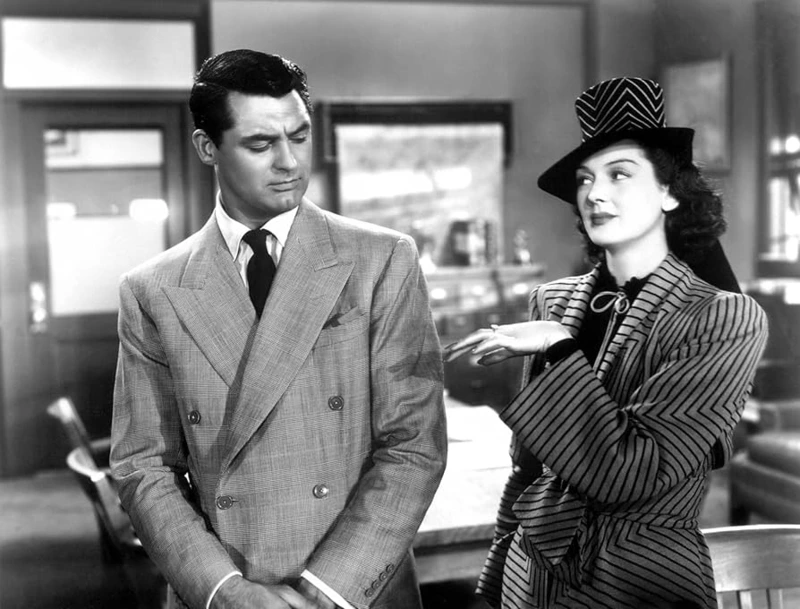
Hildy Johnson (Rosalind Russell) is leaving her high-flying newspaper job to settle down with her fiancé, Bruce (Ralph Bellamy), a sweet but simple-minded insurance man. Returning to The Morning Post office to sever ties once and for all with Walter Burns (Cary Grant), her manipulative editor – and ex-husband – who has no intention of letting her go, and uses every tool at his disposal to trick her into staying. When an apparently open-and-shut death-row case erupts into scandal and a city-wide manhunt, Hildy finds herself inexorably pulled back into the fray.
Hawks was always open about his admiration for pre-code directors Ernst Lubitsch and Leo McCarey, and their influence is all over His Girl Friday. It strikes a precise balance between cynicism and playfulness, bolstered by Hawks’ own preoccupation with professionalism and the camaraderie of tight-knit groups under pressure. Grant himself embodies the Hawksian leading man – roguish, brilliant, and most comfortable amid the chaos of the newsroom. He clearly relishes playing the more mischievous side of the character, but there’s subtlety in his performance too – the small reaction when he hears Hildy is getting married is beautifully observed. Russell is even better, giving Hildy a mixture of swagger, vulnerability, and emotional intelligence that remains startlingly modern. Together, the two are endlessly watchable – their dynamic is so much more interesting than a traditional romantic premise, and their combative verbal sparring laid the groundwork for pretty much every rom-com you can think of today.
Described by Molly Haskell as “the most positive, uncompromised screen character of her era“, Hildy is a great example of “the Hawksian woman“: she knows her mind, knows her worth, and is well aware of Walter’s nature, giving as good as she gets. And yet the film’s gender politics are not uncomplicated. It’s indicative of the time that she is constantly referred to (even by herself) as “a newspaperman”- she only gains currency in the journalism world by discarding her so-called femininity and joining the boys’ club. One of the film’s most defining scenes comes at the mid-way point: Hildy bids the newsroom a heartfelt (if sardonic) farewell, only to be cut-off by a burst of gunfire. The other reporters rush outside to catch the story; Hildy is briefly torn (in a beautiful bit of non-verbal acting from Russell) but then bolts after them, literally throwing herself back into her work. At her core, she’s a journalist and unable to let go of the thrill of chasing down a story.
Bellamy is a great foil for the central pair, a sweet, hopelessly naive man, wandering guilelessly from one jail cell to another, clutching his ever-present umbrella. The humour at his expense recalls the Cary Elwes character in Liar Liar: he does nothing wrong, yet indignities rain down on him simply because we know Russell and Grant are destined for each other. John Qualen is also affecting as the hapless, bewildered killer who may be the most likeable character in the whole film. A seemingly gentle fugitive whose repeated refrain of “I’m awful tired” makes him endearing despite his actions. Elsewhere, the film captures that standard Hawks dynamic of men hanging out – the reporters playing cards and sitting around the newspaper room recalls the camaraderie and banter of Only Angels Have Wings. Each of the reporters is given their own distinct personality, shown through the very different angles each one takes on the constantly unfolding story.
Hawks’ films are often described as visually plain, but the scenes with the reporter pool are a great demonstration of his own understated style. The overlapping dialogue was revelatory for the time; there is an impressive depth of field throughout, and fast-paced, almost expressionistic editing, cross-cutting between the reporters at moments of high tension. It might lack the visual flair or discipline of someone like Hitchcock, but it’s still a considered approach, with some cuts delayed to accommodate laugh lines, and others expedited to sustain the breakneck pacing and fluidity of the dialogue. It’s frenetic, but the story itself is always clear – as film critic Leslie Halliwell put it, “Never in the field of screen comedy have so many talked so much at one time without confusing their listeners.”
Watching today, it feels surprisingly modern. The script is playful and irreverent (at one point, Walter describes Bruce as looking “like that fellow in the movies… Ralph Bellamy“), and yet the film’s worldview is incredibly cynical and occasionally cruel. The politicians are venal and corrupt, the law officers self-aggrandising opportunists, and the newspapermen themselves cheerful vultures, gleefully exploiting tragedy for a headline. The sequence involving Molly Malloy (Helen Mack), the one character who displays genuine compassion for Williams, is especially striking. Mocked relentlessly by the reporters, she reaches a shocking breaking point that is immediately undercut by the next punchline – one of the film’s sharpest and most discomfiting tonal shifts.
Some might prefer the lightness and romance of Bringing Up Baby, but I much prefer His Girl Friday‘s combination of unsentimentality and heart. It’s an iconic, timeless comedy that manages to balance acerbic wit with pathos without ever lapsing into anything too saccharine. Hildy’s final breakdown is a perfectly judged moment that melts your heart while resolutely sticking to the stoic tone of the film. Hawks often downplayed his own skills, calling filmmaking a business and “fun,” and roundly dismissing any suggestion that he was an artist. However, His Girl Friday would suggest otherwise – it’s chaotic but precise, cynical but poignant, and classic cinema at its most exhilarating.
Special Features
This release includes the original adaptation of The Front Page, directed by Lewis Milestone and starring Pat O’Brien and Adolphe Menjou as an accompaniment to the main event. Also includes featurettes on Howard Hawks and Rosalind Russell, radio adaptations of His Girl Friday, a documentary about the restoration of The Front Page, a Programme about playwright and screenwriter Ben Hecht; Radio adaptations of The Front Page from 1937 and 1946.
★★★★★
His Girl Friday is out now from The Criterion Collection / Cary Grant, Rosalind Russell, Ralph Bellamy, John Qualen / Dir: Howard Hawks / Warner Brothers / 12
Discover more from
Subscribe to get the latest posts sent to your email.
About the Author