Everybody Digs Bill Evans Review: A Striking Depiction of Jazz Luminary
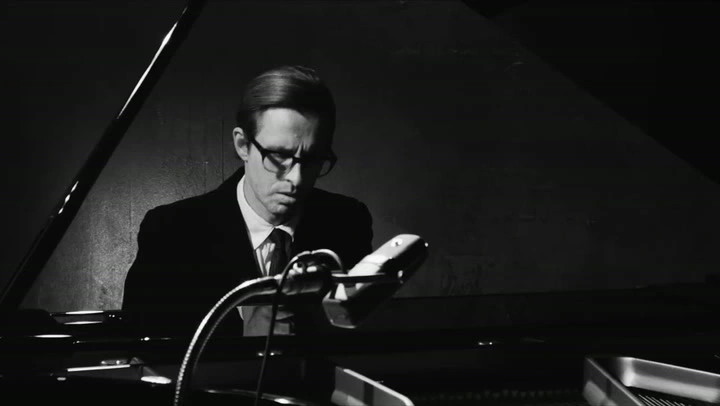
Adapted by screenwriter Mark O’Halloran, Everybody Digs Bill Evans is a moving tale about acclaimed Jazz pianist Bill Evans, based on the 2013 novel Intermission by Owen Martell.
Evans formed The Bill Evans Trio in 1959 with bassist Scott LaFaro and drummer Paul Motian. For two years, they ruled New York City Jazz bars, swooning audiences with their music. By 1961, LaFaro is killed in a car crash, and Bill’s life is upended, which is where we meet our protagonist: heartbroken, depressed and unable to perform. Bereft, he moves in with his brother Harry, his wife Pat, and their daughter Debby. Once it becomes clear that dynamic isn’t serving anyone, Bill leaves the city to move in with his parents in Florida for a short while. From here, the film’s timeline jumps between 1961 New York, 1961 Florida, 1971 New York, 1979 New York, and finally to 1980 New York, where Bill dies aged 51.
Director Grant Gee offers a whimsical portrayal of Evans’ toughest years. After LaFaro’s death, what remains of Evans is a broken man parading through a broken world. He is surrounded by equally broken people: his brother Harry Jr., a music teacher fighting his own psychological demons; his father, Harry Sr., whose new life in Florida can do no wrong; he shows off his leisurely life to his son, unbeknownst – or perhaps ignorant – to Bill’s sufferings. Throw Evans’s addict girlfriend of 12 years, Ellaine Schultz, into the mix, and he has no chance of survival: the Titanic’s stern, the final piece to sink.
Aside from being a film about music and what happens to a man of Evans’ talent when grief renders him incapable of performing, it is a film that captures addiction beautifully. Evans and Schultz are heroin addicts, and his use only worsens after La Faro’s death. Gee doesn’t portray their addiction as an ugly thing; instead, it stands to represent the two characters’ love and connection. It binds them together. The withdrawals Evans experiences in Florida subside when Schulz comes to visit. It seems that the addiction these two share is restorative rather than ruinous to their lives, perhaps because it enhances – or enables – their love for one another.
The way their addiction is captured is striking. I would usually avert my eyes at a scene of someone shooting up, but with this, you’re almost forced to stay and watch. It’s a slow, considered process; one that is elegant and gentle, without feeling harmful.
Read more of our reviews here →
The delicate pluck of Jazz chords moves you through Evans’s world; a world brimming with love, grief, addiction, and regret, captured exceptionally by cinematographer Piers McGrail. 1961 New York and Florida are in black and white, with the rest of the film’s timeline in vibrant colour: bursting with citrus oranges and yellows. Evans is Dorothy in Kansas and Oz.
The colours shift to embody the tone of the scene, capturing Evans’ emotional state. He is suffering greatly in 1961 and pulls away from jazz while he heals. By 1971 – and again in 1979 – he seems to be doing better. He knows himself better, and knows what he wants out of life. By his death in 1980, he is clearly a very sick man, but even his final moments are captured in vibrant colour through Gee’s lens; perhaps a suggestion that the great Bill Evans found peace with his fate.
While the visuals of Everybody Digs Bill Evans are striking, the timeline can feel rather fragmented. The jumps between 1961, 1979, 1971, and 1980 leave the audience to fill in the large stretches of unaccounted-for years. It’s not quite enough to leave you wholly confused by the timeline of events, but there is certainly a lot that’s left unsaid and questions unanswered – especially grating for someone with no prior knowledge of Evans’ life.
Anders Danielsen Lie is breathtaking as the titular Bill Evans. He quietly commands the screen, holding your attention without needing to ask for it first. This is not a melodramatic portrayal, but an authentic characterisation of a damaged, deeply broken yet talented man. Bill Pullman is at his best as Harry Sr., striking a perfect balance between a leisurely husband, a detached father and an ageing man. He adds a very gentle humour to this film, which is otherwise a rather solemn story. Laurie Metcalf is brilliant as Bill’s mother Mary, and Barry Ward’s portrayal of Bill’s brother Harry Jr., who harbours a childhood grudge over Bill, is compelling.
The Evans men are damaged – each haunted by something lingering in their past. Family ties, musical expressions, and golf; it seems Mary is the exception – or perhaps even the cure.
★★★★
In UK cinemas from September 11th / Anders Danielsen Lie, Bill Pullman, Barry Ward, Laurie Metcalf, Valene Kane, Katie McGrath / Breakout Pictures / 15

Discover more from
Subscribe to get the latest posts sent to your email.
About the Author



You must be logged in to post a comment.