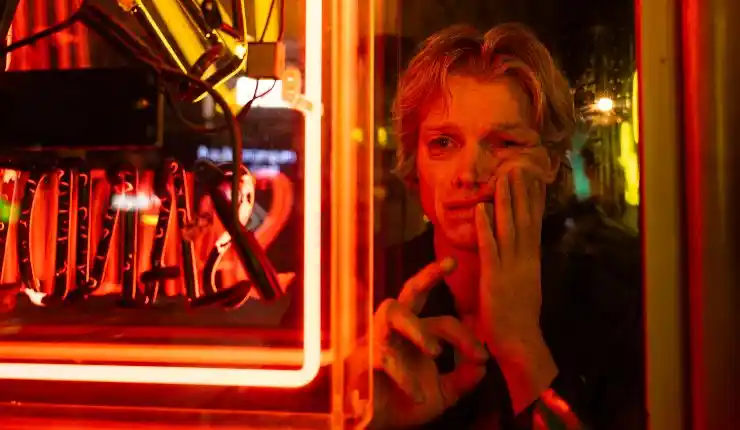
Angry Squad: The Civil Servant and the Seven Swindlers Review

Scams are rife and prey on the vulnerabilities of society and individuals. Whole TV shows are dedicated to preventing them, as if we should feel a sense of catharsis simply because an elderly person didn’t lose thousands of pounds. One has to wonder why people don’t scam the rich, those who openly boast about avoiding paying their fair share to society. Angry Squad: The Civil Servant and the Seven Swindlers, the latest film by Shin’ichirô Ueda, director of One Cut of the Dead, poses that very question. The result is a stylishly slick, thrilling yet comedically charged heist film that, while playing on familiar tropes, feels entirely fresh.
Jiro Kumazawa is a tax officer trying his best to keep a low profile and simply do his job. But when a hotshot colleague tries to pressure real estate tycoon and known tax avoider Tachibana, the situation turns hostile, and Jiro is entrapped and framed for getting physical with him. After Jiro’s boss forces him to apologise and endure Tachibana’s humiliation, Jiro’s inner rage begins to boil. However, an unlikely alliance may have formed. After being scammed and losing 800,000 yen the scammer Makoto confronts Jiro, returns the money, and proposes a deal: if Jiro agrees not to press charges, Makoto will help him scam Tachibana out of the tax money he’s been avoiding.
From there, the familiar heist tropes you know and love kick into full gear as Jiro and Makoto assemble a formidable team to plan on paper, an impossible swindle. The first 30 minutes are what allow the remaining runtime to work so effectively. Beginning as a drama, the audience, along with Jiro’s rage, slowly builds through that opening stretch as we see workers like Jiro treated as nothing more than a waste of space, mere cogs in a machine controlled by those with wealth and power. It all leads to a boiling point that may not be a satisfying twist from a surprise standpoint but absolutely is from a believability standpoint. We, too, want to swindle that money from Tachibana, so when the film’s title card drops and the story shifts into a comedic, layered heist affair, you’re fully invested in going along for the ride.
That ride can only be described as wild and deviously charming. The humour is cranked up during these moments, yet it also subverted my expectations. The idea of a civil servant becoming a swindler seems ripe for jokes about him being useless or not committed to the swindler’s life. Angry Squad avoids those entirely, instead finding humour in Jiro’s overly formal, fish‑out‑of‑water demeanour and his earnest dedication to being part of the team. It’s a refreshing shift that allows the comedy to enhance rather than undermine the heist. We never doubt the characters’ intentions or their loyalty to the cause, which lets the humour land and keeps the tension palpable.
The heist is key not only for the characters but for the film’s overall success, and Angry Squad absolutely pulls it off, delivering a heist that, while small in scale, is bold in execution. This is largely thanks to Shin’ichirō Ueda’s stellar direction. Every scene is infused with marvellous style, showcasing a clear evolution from his previous works. Even with a noticeably higher budget than One Cut of the Dead, it still feels like a film only he could have made. That increased budget also brings meaningful upgrades, one of the most striking being the cinematography. The film features several beautiful shots where Ueda holds a wide frame and simply lets the magic unfold, yet he’s equally willing to shift the visual approach to match the drama and tension. For example, when the crew starts improvising to cover for Jiro, the film adopts a more handheld style to heighten the urgency.
The other notable upgrade is the cast. Seiyō Uchino (13 Assassins, First Love) is a true delight as Jiro Kumazawa. Starting as a conformist who gradually shifts into a Robin Hood–esque figure sounds like a daunting arc, but he delivers so much emotion through subtle facial expressions and shifts in vocal inflection that the transformation feels both enticing and credible. Masaki Okada (Drive My Car, Confessions) is equally magnetic as Makoto, bringing the depth and emotional complexity needed for a character who is flawed yet irresistibly charming. This is important, especially early on, when he’s framed as a conman out to scam hardworking people out of their money.
The rest of the cast are great, especially Yukiyoshi Ozawa as Tachibana, and while the core cast members feel fleshed out, the rest of the crew exist largely to showcase their special skills. While this is common character development for heist films, I just hoped that with a smaller cast, we’d be able to dive deeper into the supporting characters’ backstories. There’s also a moment near the end that feels out of place and jarring. I won’t go into detail, as it veers into spoiler territory, but it’s a bizarre beat in an otherwise extremely polished film.
Angry Squad: The Civil Servant and the Seven Swindlers might be the biggest surprise I’ve experienced in a long time, probably since One Cut of the Dead, fittingly enough. Far exceeding my expectations, the film had me laughing and clapping with sheer joy. Despite its narrative being driven by anger, Angry Squad ultimately leaves you with the biggest and cheekiest of grins, along with a firm conviction that taxing the rich is the right way to go. I absolutely loved this film, and even though the Japanese Blu-ray lacks English subtitles, I still have a copy on the way to proudly display on my shelf.
★★★★1/2
The Japan Foundation Touring Film Programme 2026 takes place in cinemas around the UK from 6 February to 31 March 2026 / Seiyō Uchino, Masaki Okada, Yukiyoshi Ozawa, Aoi Morikawa / Dir: Shin’ichirô Ueda / 18
Discover more from
Subscribe to get the latest posts sent to your email.
About the Author