A Samurai in Time Review
Bolts of electricity are often linked to time travel, as famously demonstrated in 1984 Los Angeles. In a dark, dingy alleyway, electricity erupts, illuminating the surroundings like a flash of lightning—only for a naked Kyle Reese to suddenly fall from the sky. In Back to the Future, a key plot point revolves around harnessing the power of a lightning strike to generate enough energy to send Marty back to his own time.
Although A Samurai in Time is, at its core, a time-travel film, it employs the concept of a time jump to tell a comedic story about an Edo-period samurai who finds himself lost in a world he doesn’t recognize. Forced to adapt to modern times, he ultimately undergoes a surprising career change—becoming a film extra.
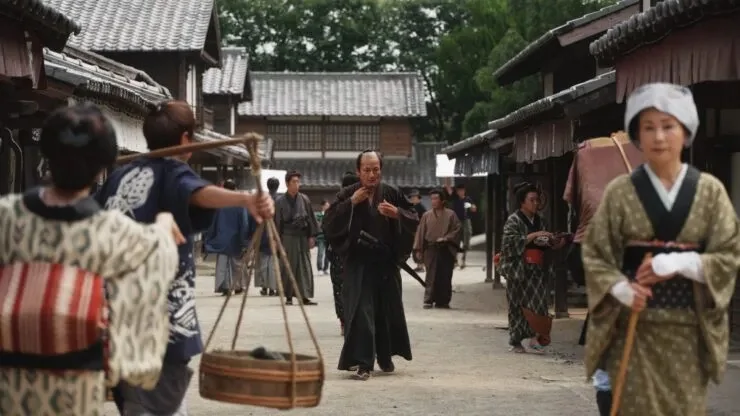
The film opens in the Edo period (1603–1868), following Kosaka Shinzaemon (Makiya Yamaguchi), a samurai of the Aizu clan. Alongside his comrade Sanosuke, he stakes out Seikeiji Temple, a known meeting place for members of the Choshu clan, where they plot their schemes. Eager to bring honor to the Aizu clan, Kosaka and Sanosuke attempt to assassinate Yamagata Hikokuro (Ken Syonozaki), a Choshu clan member. However, just as conflict erupts, a lightning strike interrupts the fight, and Kosaka suddenly finds himself in an unfamiliar setting.
As he wanders the streets, he senses that something is off. It isn’t long before he discovers the truth—he is on the set of a samurai TV show, no longer in the Edo period, but in the 21st century.
Kosaka, played pitch-perfectly by Makiya Yamaguchi, ultimately becomes a jidaigeki (period drama) stuntman. The transition from a real samurai to an on-screen samurai may not be relatable to anyone alive; however, in an era of rapid technological advancement, we understand how people must adapt to an ever-changing world. As certain jobs become obsolete, individuals are forced to acquire new skills to stay relevant. At its core, the film is about a man undergoing a mid-life career change in response to societal shifts.
Becoming a stuntman is not a seamless transition, though. Kosaka struggles with the weight of the prop swords on set, as his real swords were much heavier. He must learn how to fake—or more accurately, act—their weight. His attention to detail does not go unnoticed; over time, he becomes a highly sought-after stuntman across various productions. In the film’s second half, he is even handpicked by a legendary jidaigeki actor (Norimasa Fuke) for the star’s grand return to the genre. The film’s core message is uplifting, reinforcing the idea that, no matter our age, we all have a place in society.
In contrast to the dramatic period pieces Kosaka stars in, A Samurai in Time is an unapologetically silly comedy, featuring familiar yet effective time-travel gags. These include classic tropes like struggling to use new technology—such as a vacuum cleaner—or marveling at the moving images on a television. However, the standout comedic moments revolve around the filmmaking process. In one hilarious scene, Kosaka, convinced that he has been fatally wounded after a blood squib explodes, begins reflecting on his life, coming to terms with what he believes is his imminent death. The film also finds humor in the art of dying on screen, as Kosaka learns how to convincingly portray his characters’ final moments.
While not directly related to filmmaking, one particularly memorable scene sees Kosaka rejoicing over the fact that cake, once a luxury, is now food for the common man—before he proceeds to utterly devour it in delight.
As we approach the finale, the tension escalates, culminating in one of the most impressive sword fights in recent memory. While not as flashy as the Rurouni Kenshin live-action films or as blood-soaked as Blade of the Immortal, the cinematography masterfully balances wide shots and close-ups, accentuating the precision and danger of each strike. Great action has never required complex camera movements or hyperkinetic editing, and A Samurai in Time proves this tenfold.
By taking its wacky premise—a samurai from the Edo period becoming a 21st-century stuntman—and using it to explore the deeply relatable theme of finding one’s place in an ever-changing world, A Samurai in Time accomplishes what seems like an impossible feat. The result is a film that is both a comedic riot and a truly one-of-a-kind experience—an absolute joy from start to finish.
★★★★
The Japan Foundation Touring Film Programme 2025 takes place in cinemas around the UK from 7 February – 31 March 2025 and Out on Digital and Blu-ray on 28 April / Makiya Yamaguchi, Yuno Sakura, Norimasa Fuke, Ken Syonozaki / Dir: Junichi Yasuda / Third Window Films / 12
Discover more from
Subscribe to get the latest posts sent to your email.
About the Author