Film Review – Once Upon A Time In Hollywood (2019)

“The 9th movie from Quentin Tarantino”, posters for this say. Tarantino, having retrospectively decided that Kill Bill constitutes only one movie, despite categorically assuring us, at the time of release, that it was two, and charging us all twice for the pleasure of seeing it.
Anyway, this debatable 9th movie represents something of a complete 180 degree turn for Tarantino when compared to his earliest work, particularly Reservoir Dogs and Pulp Fiction. At the beginning of his career, Tarantino won plaudits for crafting stories that, although told in non-linear form, gave the impression of fitting together perfectly. Despite the narrative-hopping, there’s a pleasing sense of wholeness to the conclusion of his earlier work that is acutely not present here. Perhaps Once Upon a Time in Hollywood stands as the epitome of his work these days. Not films made by Quentin Tarantino, but “Quentin Tarantino movies” that are made, almost by coincidence, by the man himself. It stands almost as a mirror to what might still be seen as his masterpiece Pulp Fiction (ignore Brad Pitt’s wincingly self-reflexive flourish at the end of Inglorious Basterds). Once Upon a Time in Hollywood seems to best represent what interests Tarantino in his middle age: the ever-present fascination with verbiage but now something amounting to a collection of moments. Moments that don’t mesh together in any meaningful, or particularly satisfying sense, but ones that are, nevertheless, enjoyable on their own merit.
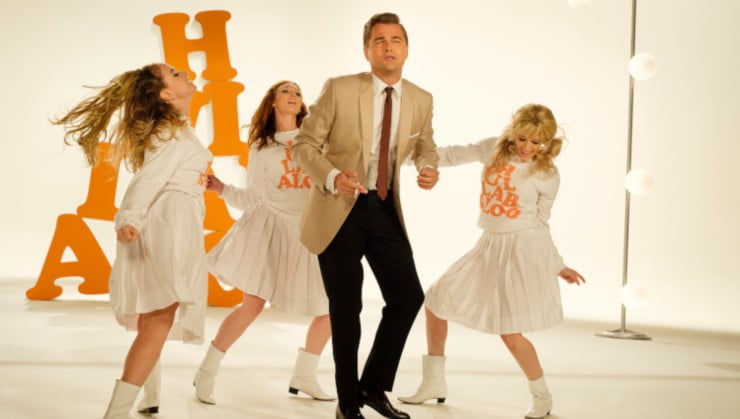
Publicity would have you believe that these moments revolve around the mass murder of Sharon Tate and her friends by the so-called Manson Family acolytes. In reality, the bulk of the moments orbit around Leonardo DiCaprio’s faded leading man Rick Dalton along with his some-time stunt double and all-round fixer Cliff Booth played by Brad Pitt. Formerly the star of a wildly successful western television show Bounty Law, Dalton has found his offers gradually drying up. He ekes out a living doing walk-on spots on other people’s shows while contemplating a move to Italian Spaghetti Westerns, about the only concrete offer he seems to be getting in the Autumn of his career. Booth, meanwhile, tags along as Dalton’s gofer, chauffeuring him from gig to gig, getting drunk with him at evenings and similarly looking back on his own career, the best years of which are behind him, with a wistfulness.
Their collective meanderings seem to repeatedly lock orbits with the numerous young hippies that crop up on street corners and are introduced with a shrill sense of foreboding. Of course, we know that these hippies will turn out to be part of the infamous cult, but their inclusion seems, initially, coincidental. Tate (Margot Robbie), meanwhile, almost literally flits and floats through the movie and is glimpsed partying with other Hollywood dignitaries of the late 1960’s without ever feeling like she has a concrete part in what we were told would be her story.

Assume you’re getting a straight home invasion movie or even anything that remotely resembles an examination of the Tate murders and you’ll be disappointed, or more likely relieved. Tarantino seems have welcomed the misconception which almost amounts to a bait-and-switch and has given us a movie that stands more as a requiem for old Hollywood. A Hollywood in 1969 right on the very cusp of the new, auteur-driven style of the 70’s. Sharon Tate and the Manson Family’s inclusion in any of it feels almost incidental to the point of irrelevance.
The end product is long, messy, unconventional and meandering, with a tone poem feel of nostalgia at times. It wavers between extended sequences of car driving accompanied by the noise of vintage radio adverts, to deep-dives into Rick Dalton’s on-set acting preparation, to rural scenes of outright horror that feel like they’ve been lifted from The Texas Chainsaw Massacre. It will unquestionably infuriate many who will view it as indulgent and without restraint, but I found it beguiling, amusing, occasionally maddening and often thrilling. Whole movements of the movie seem to have little to no connection with its other parts and yet these distinct little (sometimes rather long) moments add up to a whole that feels greater than its sum.
DiCaprio plays his washed-up star with a mixture of self-loathing, pomposity and righteous fury. An extended central scene on the set of cowboy TV show Lancer sees him expertly sink into self-doubt and panic before recovering his confidence in a rainbow of emotions featuring some genuinely superb hungover acting. If it amounts to little more than an inconsequential collage or the director’s notes on lost Hollywood as he listens to his record collection, then so be it.
By most reasonable standards of narrative storytelling it’s a mess, but it’s an entertaining mess. It’s also a lie, one which deliberately invites its audience to bask in its creator’s contagious fascination with entertainment and the myth of the town in the title.
★★★★
Comedy, Drama | USA, 2019 | 18 | 14th August 2019 (UK) | Sony Pictures Releasing UK | Dir.Quentin Tarantino | Leonardo DiCaprio, Brad Pitt, Margot Robbie, Al Pacino, Kurt Russell, Margaret Qualley
Discover more from
Subscribe to get the latest posts sent to your email.
About the Author