Dear You Review
Migration is a hot-button issue in 2026, as it seems to be every year. Migration is a normal part of how the world works, and similar trends we are witnessing now also occurred in the 1940s. Chinese film Dear You explores migration and much more, and despite its small budget, it is sending shockwaves by outperforming every metric set against it. Like Obsession, it represents a true achievement in low-budget filmmaking, while also being a deeply powerful film that will leave you reaching for tissues by the conclusion.
We open in modern-day China, where Xiaowei (Zheng Runqi) is struggling to pay off his debt. Hedging his bets on the rumoured “millionaire” Grandpa Musheng (Wang Yantong), who lives in Thailand. Xiaowei hopes his grandfather will bail him out and give him enough money to split with his uncle. Taking one of his grandma Shurou’s (Wu Shaoqing) qiaopi (remittance letters), he travels to Thailand, only to discover that his grandfather died back in 1960 and that his grandmother had been communicating with a complete stranger for years afterwards. Digging deeper, Xiaowei begins to uncover a 50-year-long misunderstanding and how two seemingly different families are more connected than they appear.
Dear You, at its core, is about family. Early on, it is revealed that Musheng fled his village, leaving behind his wife and children to avoid conscription during the Chinese Civil War. Typically referred to as Xia Nanyang, this form of migration was a crucial factor in the rise of the Chinese population in countries like Singapore and Malaysia, which was primarily driven by poverty and war. Despite fleeing to escape conscription, Musheng remains a man of integrity, ensuring that, even from thousands of miles away, he continues to support the people he loves, his family.
This love comes with sacrifice. By not being able to save money for himself and giving every spare penny to his family, Musheng effectively guarantees that, for the foreseeable future, he will never be able to return home and reunite with the ones he loves. This idea of parental sacrifice, while shown through the lens of physical separation from loved ones, is something that can be relatable for many parents, particularly single-parent households, which I personally experienced. For a single parent, their children are their whole world, and they will do anything to ensure their lives are as normal as possible, even if that means sacrificing their own happiness.
Family can be viewed as the backbone of communities, and throughout the film, we see how the Chinese community comes together. Whether it be supporting people during times of hardship or sharing the little money they have so that others can send their qiaopi. While its portrayal could be seen as somewhat naïve and lacking in the more complex realities of the situation, as not everyone would have been as morally good as Musheng, it is nevertheless executed with precision. Allowing the film to remain emotionally resonant, leaving me teary-eyed on a few occasions.
However, due to the nature of the film, language and, in a way, education become important ideas that it explores. While not the film’s central theme, we see that many Chinese citizens struggle to read or write, with only a select few able to understand the letters at the heart of the story. Language becomes a way to connect with our familial roots, but it is also essential for self-expression, whether through declarations of love or simple communication. The film demonstrates that without proper language education, we cannot truly connect with others.
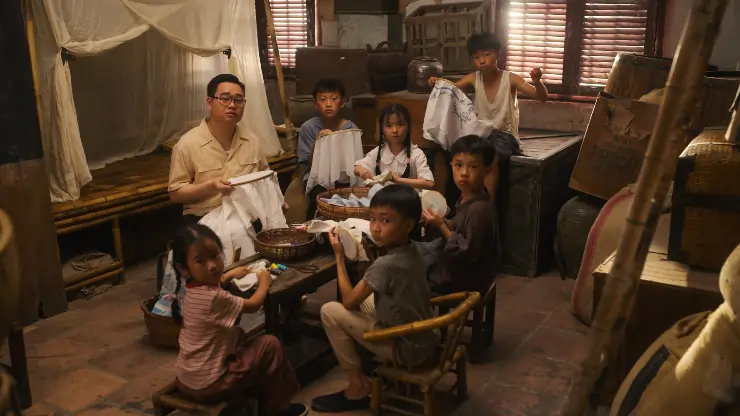
Despite being low-budget and featuring many relatively unknown actors, the film feels massive in its presentation. It is driven by stellar performances, especially from Li Sitong as Xie Nanzhi, whom I have intentionally not mentioned until now, as going in knowing as little as possible about her character allows for the greatest emotional payoff. Another standout is Wang Yantong as Musheng, who is truly scene-stealing and brings a layered complexity to the role. Visually, the film is also striking, transporting us seamlessly to 1940s and 1950s China and Thailand, while equally capturing their modern-day counterparts. This is achieved through a strong combination of lush cinematography and exceptional set design.
Dear You is one of the most powerful and emotionally resonant films I’ve seen all year. Continuing a notable trend in 2026, East Asian cinema has by far delivered some of the strongest outputs of the year. As someone who considers themselves emotionally resilient—and believes no film can truly break them—this one left me an emotional mess by the end. I was deeply moved by its story, which beautifully showcases themes of family, integrity, loyalty, and language. It is a truly masterful work of art that deserves a place on everyone’s watchlist.
★★★★ 1/2
In UK cinemas from 26th June / Li Sitong, Wang Yantong, Wu Shaoqing, Zheng Runqi, Wang Xiaohui / Dir: Lan Hongchun / Trinity CineAsia / 15
Discover more from
Subscribe to get the latest posts sent to your email.
About the Author